Monday, August 13, 2012


Dept of Bio-Chemistry
University of Calcutta 


Human dependence on coastal ecosystems is increasing at an unprecedented rate, which is likely to rise to over nine billion by 2050, according to United Nations Population Division. The impacts of human pollution and habitat alteration are most evident and of greatest concern at the microbial level, where a bulk of production and nutrient cycling takes place. Vibrant marine and coastal ecosystems provide valuable services in terms of nutrition security, resources for economic development and restitution to a weary being as he scouts for some places along the shoreline in the quest of tranquillity. The changes in ocean chemistry due to global warming or greenhouse gases will adversely affect the physical and biological characteristics of coastal systems, modifying their ecosystem structure and functioning. As a result, coastal nations face losses of marine biodiversity, fisheries, habitat loss, nutrient pollution, shorelines, etc. unless some scientific intervention is there for restoration of the equilibrium.
The eastern part of the coastal region of West Bengal is characterized by the spectacular mangrove forest of Sundarbans. The forest performs several important ecological functions for its sustenance. On one hand, the mangrove forest acts as a bio-shield against severe storms and cyclones coming from the Bay of Bengal that have the potential of causing large scale damage to the coastal areas. On the other hand, the mangrove forest participates in complex physical, chemical and biological interactions that produce a unique ambience for healthy and luxuriant growth of the forest. People living in and around the forest draw their livelihood from the living and renewable resources provided by the forest. The forest acts as a sink of carbon in as much as it is suspected that they emit methane, a greenhouse gas, to the atmosphere. It is also known that carbon dioxide is produced by heterotrophic activity in a mangrove swamp. However, a correct assessment of the contribution of mangrove forest towards controlling the climate change/global warming is still not available due to absence of reliable measured data. Conversely, the expected changes in carbon bio-geochemical cycle in the mangrove system in relation to the anticipated climate change/global warming are still to be understood due to the aforementioned reasons.
The life forms in the Sundarbans have a complex inter-related existence to maintain equilibrium dynamics within the extant of physical and chemical environment. The mangrove produces rich organic debris (consisting of decaying spores, pollens, seeds, leaves, fruits, twigs and branches of trees, etc.) due to its high biological productivity with unique concentrations of nutrients in the debris.  The nutrients are released both to the water and soil of the mangrove wetland of Sundarbans. Parts of these “foods” are consumed by a group of organisms (like fishes, birds, amphibians, mammals, etc) either directly or through the water or the soil medium to sustain their body metabolic functions. The other parts are assimilated in the substrate soil, “consumed” by various forms of microbes which return some part of the “digested” consumed food to the soil as organic fertilizers. The fertilized soil (humification) thus supports further luxuriant growth of the mangrove forest. There is, however, a residual flow of nutrients and organic carbon from the mangrove system to the coastal water. The microbial diversity of a mangrove forest is mind-boggling and the various forms interact with the environment at various energy levels to set up a complex food web and growth of mangrove vegetation.

Background
It has been noted that the coastal and estuarine wetlands in the Sundarban region are in dire risk due to sea-level rise and saltwater intrusion. The impact of natural and anthropogenic stressors on biogeochemical cycles in coastal and inland wetlands is also taking its toll on the fragile ecosystem of Sundarban as gradually the salinity gradient moved into the saline/tidal marshes, then brackish marshes, freshwater marshes, and ending with freshwater/forested wetlands.


It has been worked out that within the ICZMP, Calcutta University will act as one of the Pilot Investment Executing Agencies that will perform basic research work to explore diversity of microbes in Sundarban and their role on withstanding coastal erosion and other ecological processes, etc. The University of Calcutta is supposed to investigate the following:-
·         Understanding the functioning of the Sundarbans mangrove system through the research on activities of the microbes present in the substrate sediments and understanding the role of microbial diversity in maintaining the system.
·         Understanding the natural process of capture of carbon and emission of greenhouse gases from mangrove forests of Sundarbans thereby assessing the contribution of mangrove forest towards controlling global warming.
·         Predicting the changes in carbon bio-geochemical cycle in the mangrove system of Sundarbans in relation to climate change/global warming.
·         Understanding the natural process of flow of the nutrients and organic carbon from the mangrove system to the coastal sediment and water in Sundarbans to self-support the mangrove system of Sundarbans.  
·         Assessing the amount of carbon sequestration through mangrove forest of Sundarbans towards controlling global warming.

In order to achieve the above objectives, one research program has been envisaged. Planned procurement of the instruments as envisaged in the present project will essentially support two research programs as part of capacity building of the participating departments of the Calcutta University.
The first program will involve collection of representative soil and water samples from areas of Sundarbans having different vegetation assemblages and analysing the microbial diversity using structural and functional metagenomics. For this purpose one Pyrosequencer and Thermocycler or PCR machine have already been purchased. Pyrosequencer is the main instrument which provides detailed DNA sequence of the DNA samples. Pyrosequencer can also be used for performing both structural and functional metagenomics in order to understand microbial diversity. A Gel Documentation System has also been procured. Thermocycler has been used for the purpose of DNA amplification.
The program includes the following objectives:
  • measurement of CO2 sequestration and CH4 emission from the mangrove forest and water,
  • estimation of bacterial abundance (BA) and bacterial productivity (BP),
  • measurement of inadvertent fertilization by nutrient flux (dissolved inorganic nitrogen), dissolved inorganic phosphate silicate from rivers
  • measurement/estimation of residual flow of nutrients and organic carbon from the mangrove system to the coastal water

The other instrumental facilities that have been procured are:
·         Upright wide field research microscope with bright field, dark field, phase contrast and fluorescence with CCD camera and software
·         Total carbon analyzer
·         Liquid scintillation counter
·         Variable temperature programmable Incubator with Shaker system (BOD incubator)
·         Nitric oxide analyser
·         Fluorescence spectrometer with life time measurement

The University of Calcutta planned to execute the entire task in micro stages that are as noted as:
¨       Reconnaissance survey of the entire area, selection of field stations, gathering of basic knowledge about the area, recruitment of research personnel, procurement of instruments.
¨       Sample collection for bacterial culture and to undertake organic, pollutant and chemical analysis of coastal sediments.
¨       Metagenomic analysis and cataloguing of bacterial population.  Estimation of primary productivity of the ecosystem. Measurement of nutrient flux.
¨       Collation of data and Information, computational and bio-informatics study, model development.


Expected Outcome
Expected outcome of the project is cataloguing and describing the microbial diversity of Sundarban which is needed for the conservation and sustenance of this heritage site. The capacity building through this project will also construct an instrumental facility to support marine research. The third outcome is to create awareness among the new generation regarding the importance of coast and marine areas.

The project cost has been estimated at `5.6 crores out of which capital cost will be about `3.125 crores towards procurement of equipment and recurring cost will be about `2.475 crores. 

Sunday, July 1, 2012


Department of Disaster Management, Government of West Bengal

The Sundarban Delta Complex which has geo-genetic link to the tectonic Bengal Basin known for its startling coastal landforms that include back dunal mudflats, back swamps, saltmarshes and tidal creeks enshrouded with mangrove vegetation, low gradient supratidal and intertidal shores with mud bank, swales and berms, rivulets, tidal flats etc. However despite the mind boggling floral and faunal diversity Sundarban is very much vulnerable to natural hazards e.g. storm surge, flood, tidal wave, cyclone etc. Moreover due to rising sea level, the existing coastline is retreating at alarming rate which is symptomatic to some impending natural catastrophes. The inhabitants of the Sundarban estuary probably have acclimatized themselves how to live on facing the nature’s wrath. Sundarban is still recuperating   from the brunt of Cyclone Aila that devastated thousands of hectares of once fertile agricultural land adjoining the mangrove forests into a wasteland. The loss of human life and property is beyond any estimation in real terms. The aftermath of these kinds of cyclones and storm surges is on the livelihood of the people at large as due to the ingress of saline sea water into the lush green fertile fields used for paddy cultivation, these tracts of land rendered useless for any kind of agricultural activities.
The ICZM Project understands that fructification of the project can be done only when the people living on the vulnerable coastal zones can be safeguarded to a certain extent from the natural calamities like flood, cyclone, hail storm, thunder squall and sometimes even to tsunamis that occurred due to geo-morphological, climatic and seismic conditions. 

 Department of Disaster Management, Government of West Bengal has been entrusted with the construction, operation and maintenance of the proposed Multi-Purpose Cyclone Shelters (MPCS) as envisaged in the ICZM Project. The estimated cost of the project is 32 crores. Department of Disaster Management has been assigned this project component because it plays a pioneering role in establishing necessary systems, structures, programs, resources, capabilities for reducing disaster risks in the State in order to save human lives and property, avoid disruption of economic activity and damage to environment and also to ensure the continuity and sustainability of development.

The construction of MPCS will not only pave the way for increasing the resilience of the communities during calamity, but also opening avenue for social coordination and enhanced capacity to shoulder responsibility by operating the shelters in a gainful pro-social way.

The MPCS has a multi–pronged approach in catering to the needs especially of the disadvantaged sections of the populace through a string of activities such as:-
1.    Minimization of loss of lives, property and livestock by providing it shelters during cyclone calamity
2.    MPCSs will act nodal points for receipt and dissemination of cyclone warnings
3.    MPCSs will provide the warehousing facilities of essential stocks/ items for post disaster  usage
4.    The nodal points for carrying out post disaster response and relief activities will be from MPCSs
5.    MPCSs will also provide temporary protection from the heavy downpour during the  monsoon and also from the scorching heat during the summer to the shelter less people
6.    Basic health services like immunization programmes can be administered through these MPCSs
7.    MPCSs will acts models for safe construction in vulnerable seismic zones.

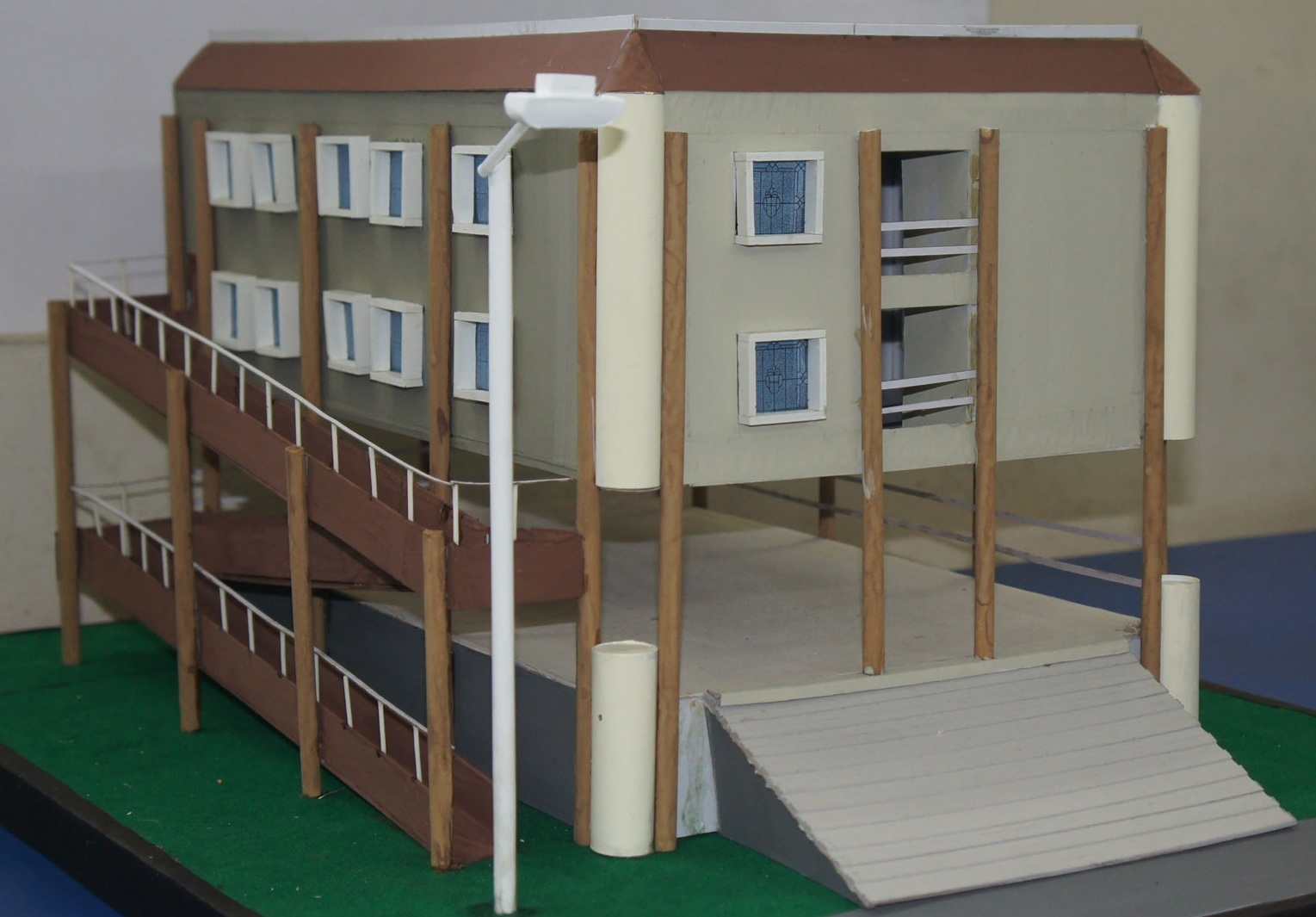
The basic design of the MPCSs is that it will be of 3-storied building with stilted ground floor without any wall for keeping the rescued livestock during disaster times. The construction of the MPCSs will be done keeping in mind the hydrostatic and hydrodynamic forces that may be exerted upon the MPCSs whenever such eventualities arise. The proposed MPCSs will have separate living area, drinking water and toilet facilities for men and women. Water would be pumped to tanks on roof top in normal course and also prior to occupation in case of a disaster warning. Bore well with hand pump will be provided near shelter in villages having no piped water supply scheme. MPCSs will be equipped to provide facilities for basic medical relief during and after the disaster. MPCSs will also have separate allotted spaces for keeping valuables and household treasure troves. The MPCSs will have provisions for Kitchen utensils and Gas Chula. MPCSs will also be fortified with necessary equipment whose requirements are high during the time of exigencies such as:-

¨       Generator Sets
¨       Light & fans
¨       Life Buoy
¨       Life Jacket
¨       Rope
¨       Stretcher
¨       Telescopic Aluminum Ladder
¨       First Aid Box
¨       Fire extinguisher
¨       Notice Board
¨       Black Board
¨       Solar lantern
¨       Inflatable Tower Light
¨       Portable Power Saws
¨       Siren
¨       Hand Held Mega Phone
¨  Flexi-water tank with 
   200 lit. capacity
¨       Hand Held Search Light
¨       Foldable stretcher
¨       Free Power Radio
¨       Water Filter
¨       Foldable Stretcher
¨       Steel Almirah
¨       Repair Kit (Shovel, Trowel, Kadei, Hammer, Chisel)
¨       Rescue Kit

There will be MPCS Beneficiary Committees (MPCSBC) comprising the elected member of Gram Panchayat and four/five other local persons for each of the MPCSs for keeping constant vigil on the quality of materials and construction.

          Operations & Maintenance of Proposed Cyclone Shelters
It is proposed that, after construction, the management of the cyclone shelters would be entrusted to the District Magistrates, who, in their turn, would hand over those to the Block Development Officers(BDO). The BDOs will hand over possession and maintenance to MPCS Maintenance Committees (MPCSMCs) comprising the elected member of Gram Panchayat and four/five young and energetic villagers. In cases where the shelter is proposed to be used as a School, it shall be entrusted to the Department of Education. Gram Panchayats will form Multi-purpose Cyclone Shelter Management Committees in respective villages and that will be intimated to the concerned BDOs for incorporating their names in a register. The MPCSMCs will be in charge of day-to-day maintenance and monitoring of the shelters in those sites which will not act as schools. The committee will collect suitable maintenance fees from the users by putting them to economic use for social functions and community based socio-cultural activities such as:
  • Community centre for functions on a rental basis
  • Anganwadi centres
  • Artisan complexes
  • Integrated service delivery centre for the activities like training programmes, group meetings of youth, men and women
  • Health camps
  • Veterinary camps
  • Welfare hostels

Wherever the asset is utilized by the Department of Education to operate as primary schools, the maintenance activities, standard security measures and drills will be carried out by the Head teacher of the school.  In other cases where the MPCSMCs operate and maintain the asset, the responsibility of security and maintenance measures will be carried out by the Block Development Officers.  The costs towards such measures and maintenance will be drawn from the regular operational budgets of the Department of Education and Disaster Management, as the case may be.

Corpus fund for maintenance
For sustainable maintenance of the shelter buildings, it is proposed that a corpus fund of Rs. 3,00,000/- per shelter will be created.  The corpus fund will be kept in a fixed deposit scheme with a locking system for three years in the nearest nationalized bank or post office in the joint account of the MPCSMC. The MPCSMC cannot withdraw the amount or the interest accrued for first 3 years. After 3 years, the capital and the interest will form the capital for the next term of deposit. The interest accrued from the said deposit only can be withdrawn by the MPCSMC in the 6th year and be spent for maintenance of the building. The committee cannot withdraw the principal amount at any point of time and without prior permission of the concerned district magistrate. They can only utilize the annual interest accrued on the deposit and can spend along with the users fees collected towards maintenance of the MPCSs.  The unspent interest will be deposited in the joint account for expenditure in the subsequent years.

Capacity Building

The Department of Disaster management has also embarked upon to conduct some training sessions which will help in mitigating the risks owing to the occurrence of natural hazards to a certain extent. The Search and Rescue training will be as per the standardized specification of Civil Defence Organization in the State. The First Aid training will cover all the major aspects of first-aid techniques. The training format will be as per the specification of Indian Red Cross Society and St. John Ambulance and the training will be imparted by the trained lecturers of the aforementioned organizations.
Teachers will be sensitized on basic disaster preparedness aspects and school safety measures to disseminate information to the students. School Education & Mass Education Departments of the government of West Bengal will be requested to keep at least one hour of time in a week for the students of high schools for disaster awareness generation.
The local NGOs and CBOs will be involved in the public interactive platform component for creating mass awareness. Display of educational video films and posters pertaining to natural catastrophes will be publicized at the community level. The NGOs will be chosen in consultation with State Inter Agency Group, West Bengal. District Magistrate, South 24 Parganas, will be the mainstay in this programme for conducting all trainings in the district smoothly and in a structured way. Three-tier Panchayat Raj Institution will be fully involved along with the district administration for better coordination in the field level activities to be taken up under the programme.


Tuesday, June 19, 2012

INTEGRATED COASTAL ZONE MANAGEMENT


Integrated Coastal Zone Management (ICZM) Project, West Bengal
The Ministry of Environment and Forests, Government of India (MoEF) requested the assistance of the World Bank for financing an investment project referred to as “India: Integrated Coastal Zone Management Project” (hereinafter referred to as “ICZM Project” or the “Project”), with an overall objective of assisting the Government of India in building national capacity for implementation of the new integrated management approach for India’s coastal zones, and piloting the integrated coastal zone management approach in the three states of Gujarat, Orissa and West Bengal;
The Project includes four components (Component One: the National Component has the specific objectives to establish and support an appropriate national institutional structure for guiding and coordinating coastal zone management, including, as sub-components: (a) hazard line and coastal sediment cell mapping; (b) mapping of ecologically sensitive areas; (c) establishing a new national institute for sustainable coastal zone management; and (d) national level capacity building; and Components Two, Three and Four aimed at piloting the integrated coastal zone management approach in Gujarat, Orissa and West Bengal, respectively);
To exclusively lead implementation of the Project, and to achieve the Project Development objectives for the West Bengal Component of the Project, the Government of West Bengal has created a special purpose vehicle, called the West Bengal State Project Management Unit (SPMU), and has appointed the Institute of Environmental Studies & Wetland Management, Salt Lake, Kolkata to be the SPMU;
Component Four for West Bengal, aimed at developing and empowering state level authorities to adopt appropriate ICZM approaches consistent with national strategies, includes sub-components: (a) preparation and adoption of an ICZM plan for the coastal stretches of West Bengal; (b) institutional strengthening and capacity building at the State level; and, (c) pilot investments consistent with local ICZM priorities around three themes of (c-i) Conservation and protection of coastal resources; (c-ii) Environment and pollution management; and (c-iii) Livelihood security of coastal communities.
Duration of the Activity: The execution of the Activity will be carried out between the 1st September, 2010 to 31st August 2015. Total cost of the project will be Rs. 300.26 crores out of which Government of West Bengal shall have to make a payment of about 7%. Rest 93% Which comprises of the loan from the World Bank and the matching grant from Government of India will come as a grant to Government of West Bengal.
The activity (a) above will be implemented by SPMU, and activities under (b) and (c) above in West Bengal will be implemented in partnership with the following Pilot Execution Agencies – Calcutta University (CU), Institute of Environmental Studies and Wetland Management (IESWM), Directorate of Forest, Government of West Bengal, Zoological Survey of India (ZSI);  Public Health Engineering Directorate (PHED), Government of West Bengal, and Digha-Shankarpur Development Authority (DSDA). West Bengal Fisheries Corporation Limited (WBFCL), West Bengal State Electricity Distribution Company Limited (WBSEDCL), Sundarban Infrastructure Development Corporation Limited (SIDCL), Department of Disaster Management, Government of West Bengal

West Bengal coast can be divided into three major sectors namely : Sundarban sector (Mangrove area), Haldia sector (Industrial area) and Digha Sector (western part of West Bengal with sandy beach and micro-tidal range). ICZM Project has planned to make investment in two focal areas, namely   : (a) In Sundarban Sector – Sagar Island (under Sagar Block) and (b) Digha-Shankarpur area in western coast. All the development works under this project will be concentrated in these two areas. The details of work to be undertaken in two sectors are as follows:
(a)  Sagar Island :
       i)            Sundarban Infrastructure Development Corporation Limited (SIDCL) will undertake the responsibilities for planning, designing and executing the activities related to the Pilot Investment in the Project for (i) Development of eco-tourism in Sagar Island and (ii) Livelihood Improvements and Market access in Sagar Island, South 24-Parganas District, West Bengal. The total cost of the Activity will not exceed Rupees 6463  lakhs (Rupees sixty four  crores sixty three lakhs).

     ii)            The West Bengal State Electricity Distribution Company Limited (WBSEDCL) will undertake the responsibilities for planning, designing and executing the activities related to the Pilot Investment in the Project for Distribution of grid electricity for household connections in Sagar Island. The total cost of the Activity will not exceed Rupees 3470 lakhs (Rupees thirty four crores seventy lakhs).

(b) Digha – Shankarpur Area

       i)            The Digha–Shankarpur Development Authority (DSDA) will undertake the responsibilities for planning, designing and executing the activities related to the Pilot Investment in the Project for (i) Beach Cleaning & Sanitation, Environmental amelioration along the Beaches, Livelihood Generation etc. (ii) Solid Waste Management and (iii) Development of Drainage System and Phytoremediation at Digha, Purba Medinipur District, West Bengal. The total cost of the Activity will not exceed Rupees 6,525  lakhs (Rupees sixty five  crores twenty five lakhs) out of which SPMU will provide Rupees 6509 lakhs (Rupees sixty five crores nine lakhs).   
     ii)            Public Health Engineering Directorate (PHED), Government of West Bengal, will undertake the responsibilities for planning, designing and executing the activities related to the Pilot Investment in the Project for Renovation of Sanitary Sewerage Scheme for Digha area. The total cost of the Activity will not exceed Rupees 3559 lakhs (Rupees thirty five  crores fifty nine lakhs) out of which SPMU will provide Rupees 2982 lakhs (Rupees twenty nine crores eighty two lakhs).
   iii)            West Bengal Fisheries Corporation Limited will undertake the responsibilities for planning, designing and executing the activities related to the Pilot Investment in the Project for Post Harvest Handling and Fish Auction Centre at Digha Mohana. The total cost of the Activity will not exceed Rupees 681 lakhs (Rupees six  crores eighty one lakhs).
   iv)            Zoological Survey of India (ZSI), Government of India, will undertake the responsibilities for planning, designing and executing the activities related to the Pilot Investment in the Project for Strengthening of Marine Aquarium and Regional Centre  at Digha. The total cost of the Activity will not exceed Rupees 593 lakhs (Rupees five  crores ninety three lakhs) out of which SPMU will provide Rupees 268 lakhs (Rupees two crores sixty eight lakhs).
     v)            The Directorate of Forests will undertake the responsibilities for planning, designing and executing the activities related to the Pilot Investment in the Project for Afforestation Programme towards Coastal Protection around Digha – Junput area. The total cost of the Activity will not exceed Rupees 539  lakhs (Rupees five  crores thirty nine lakhs).
 In addition to these sector specific works, some general development work along the entire coastal West Bengal will also be undertaken foe ensuring safety and security of the coastal communities. Directorate of Relief, Government of West Bengal, will undertake the responsibilities for planning, designing and executing the activities related to the Pilot Investment in the Project for Construction of Cyclone Shelter Facilities in Coastal West Bengal. The total cost of the Activity will not exceed Rupees 3,200 lakhs (Rupees thirty two crores).
Capacity Building Programme
       i)            The University of Calcutta will undertake the responsibilities for planning, designing and executing the activities related to the Pilot Investment in the Project for Capacity Building for Biodiversity Studies in Sundarbans. The total cost of the Activity will not exceed Rupees 560 lakh (Rupees five crores sixty lakhs).
     ii)            Institute of Environmental Studies Wetland Management (IESWM) will undertake the responsibilities for planning, designing and executing the activities related to the Pilot Investment in the Project for Capacity Building for Modeling of form-process-response in Sundarbans due to Climate Change. It also includes a small component of supporting in construction and operation of an Interpretation Centre on the Sundarbans by  Tagore Society for Rural Development. The total cost of the Activity will not exceed Rupees 824 lakh (Rupees eight crores twenty four lakhs).    

        Public Health Engineering Department


Digha has turned out to be one of the favourite destinations where a causal day tripper wishes to visit repetitively in a bid to “drink life to the lees” for some time while shoving out the mundane activities that fatigues the human intellect to the nadir of restiveness.


 However with rising population and inrush of inbound tourists Digha’s tryst with hygiene turned out to be a major cause of an impending environmental hazard which will have serious ramifications on the entire coastal ecosystem adjacent to Digha. In the Digha area because of growing population, large urban tourist influx and construction of hotels and restaurants the problems of sanitation related waste management and treatment including construction of a sanitary landfill along with vermi-compositing facility, construction of underground sewer lines and a sewage treatment facility are required to be addressed.
 Presently raw sewage from the existing buildings whether residential, commercial, hotels etc. are treated in individual septic tanks as on-site sanitation and final effluent of septic tanks are discharged either through individual soak pits or directly into the existing surface drains. As a result the flows in the surface drain become septic sullage or septage which is not at all desirable in such a popular beach resort. The situation become more aggravated as some hotels and holiday homes violate the regulations set by the Environment Department, Govt. of West Bengal, by disposing their sewage into the surface drain without any treatment. Discharges from these surface drains are disposed to the sea directly causing public health hazards along the shore line which requires adequate treatment to protect receiving waters from oxygen depletion and ecological damage. Considering the same Environment Department, Govt. of West Bengal felt the need of preparation of a Sanitary Sewerage Scheme for Digha beach resort which will be constructed by the Public Health Engineering Directorate, Govt. of West Bengal and will be maintained under Digha Sankarpur Development Authority (DSDA).

A flashback of not so remote period will entail the fact behind the wobbly and asymmetrical scenario of the incumbent sanitary sewage scheme at Digha.  The Sanitary Sewerage Scheme for Digha was sanctioned earlier in the year 1996 for an estimated cost of Rs. 4.09 crores considering a design population of 17,000 in the design year 2011. After laying of about 1825 mtr. sewer line some problems of sand boiling were faced in some places and work was suspended, temporarily, in the year 1997. To overcome such problem re-design of the entire system was done in 1999 to safeguard against sand boiling problem and suspended work resumed in the year 2000. Based on the re-design a considerable part of the work was completed within the sanctioned amount of Rs. 4.09 crores. However as the entire sewer network had been re-designed it was not possible to execute all works of the scheme within the sanctioned amount due to cost escalation and other allied corollaries. Accordingly, revised estimate was prepared subsequently and it was proposed to execute the work in 2 phases. Value of the revised estimate was Rs. 12.51 crores comprising of works for Phase-I and Phase-II. Estimated amount for Phase-I works was proposed as Rs. 8.89 crores and for Phase-II works was Rs. 3.62 crores. But the said revised estimate was not sanctioned and as a consequence, works remains suspended till now for want of requisite fund.

 Under the stated circumstances and considering the necessity to improve the hygienic condition as well as to maintain the environmental standard of the popular beach resort the renovation work of the suspended Sanitary Sewerage Scheme of Digha area has been considered as one of the pilot investment scheme under ICZM Project to be executed by Public Health Engineering Directorate.

Objective of the Proposed Sewerage System

With the growing population the management of solid waste turned out to be a critical affair as if untreated wastewater is allowed to accumulate, the decomposition of the organic matter it contains can lead to the production of large quantities of mal-odorous gases. In addition the untreated wastewater usually contains numerous pathogenic or disease-causing microorganisms that dwell in the human intestinal tract. It also contains nutrients, which can stimulate the growth of aquatic plants, and it may contain toxic compounds. For these reasons, the immediate and nuisance-free removal of wastewater from its sources of generation, followed by treatment and disposal, is not only desirable but also necessary for the society to improve the hygienic condition as well as to maintain the environmental standard of the area. The ultimate goal - wastewater management - is the protection of the environment in a manner commensurate with economic, social, and political concerns.

The objective of the sewage treatment is to stabilize decomposable organic matter present in the sewage so as to produce an effluent and sludge which can be disposed of in the environment without causing health hazards or nuisance. Health hazards are also created due to the bacteriological contamination in the underground water and also to the surface water bodies. Therefore, treatment of Sanitary Sewage in the Digha area becomes essential to safeguard the health hazards of the people of the area as well as to the visiting tourists and also for the protection of the coastal ecosystem of the popular beach resort.

Proposed Project Component:

In the renovation work of the present scheme, different diameter sewer lines are to be laid except sewer lines constructed earlier. In the proposed system, the sewer network of 18,646 meter length of different diameters will collect sewage from the entire command area and will transmit the same to the Sewage Treatment Plant. Out of total sewer line, a length of 6,496 meter of different diameter sewer lines were laid earlier according to the initial sanction and remaining 12,150 meter sewer lines of different diameter are to be laid as per proposed renovation work. Sewer lines already constructed earlier are to be cleaned thoroughly to make those lines functional as those lines are lying idle for quite a long time.

 Sewage from residential houses, hotels, different Institutions, commercial and other establishments will be collected through different manholes of different sizes to be provided at regular intervals, as per requirement, within the sewerage network. Manholes will be provided within the sewer network at an interval of 30 mtr. or less based on requirement. Considering the necessity from the engineering perspective it has been proposed to construct ordinary manholes, junction manholes, drop manholes and flushing manholes at different locations within the sewerage network. Provision of flushing manholes at the head of sewer have also been kept for flushing the system once or twice a day to wash away deposited solids of the sewer. Manholes to be provided within the sewerage network will also act as inspection manholes and will also be utilized for inspection, cleaning and other purposes at the time of operation and maintenance.

 As the soil condition is not favourable for laying sewer along deeper level, due to sand boiling problem in some areas, it was decided to lay sewer comparatively along shallower depth to facilitate easy construction. Accordingly provisions for 4 Sewage Lifting Stations have been made at suitable locations adjacent to sewerage network system. Out of which 3 Sewage Lifting Stations have already been constructed earlier as per initial sanction and the remaining 1 Sewage Lifting Station is to be constructed under the proposed renovation work. Besides Sewage Lifting Stations provision of 2 main Sewage Pumping Stations has also been made in the present renovation work to facilitate pumping of accumulated sewage into the Sewage Treatment Plant. Out of these 2 Sewage Pumping Stations one has already been constructed earlier and the other Sewage Pumping Station will have to be constructed under the present renovation scheme.

The sewerage network of the proposed renovation scheme has been designed in such a way so that these Sewage Pumping Stations can function independently. Accumulated sewage of these pumping stations will be pumped separately and will be collected in a collection chamber before entering into the sewage treatment plant and will then be distributed uniformly from the collection chamber to the treatment ponds.

The treatment process to be adopted for the present scheme has been decided after comparative study of advantages and disadvantages among several treatment technologies available now-a-days and after such comparative study it has been decided that waste stabilization pond comprising of anaerobic, facultative and maturation pond will be the best option for treating sewage of Digha Township. The degree of treatment to be provided has been decided by comparing the raw waste water characteristics with respect to the required standard of final effluent to be discharged according to the set provisions. Main advantage of this process is that this process does not require any mechanical equipment for operation and as a result no electrical energy will be required for the plant operation which in the process will drastically cut down the operational cost. But the main disadvantage of the process is that it requires large area of land but as the land is available free of cost from Digha Sankarpur Development Authority (DSDA) waste stabilization pond has been selected for the treatment of sewage of Digha Township. Waste stabilization pond is also the simplest of all waste treatment technologies available for sewer waste water because of its simplicity and reliability of operation. A stabilization pond is simply a shallow body of water contained in an earthen basin exposed to sun and air.

The total estimated cost of the renovation work of Digha Sanitary Sewerage Scheme comes to `35.59 crores comprising of costs related to civil works as well as mechanical/electrical works. This cost also includes charges for service connection as well as cost of trial run coupled with operation and maintenance costs for the initial 3 years after commissioning of the project.

Execution of the present scheme will be done through turnkey contracts with provision of 3 years operation and maintenance by the executing agency including performance guarantee after successful commissioning of the entire system. Thereafter, the scheme will be handed over to the Digha Sankarpur Development Authority (DSDA) for operation and maintenance.

Along with the aforementioned sewage network PHED is supposed to construct a building within in the adjacent areas of Hospital at Digha. The proposed building will serve multiple purposes as it will have allotted room spaces for discharging administrative duties and responsibilities, laboratory, staff quarters, rest shed, stores, etc.  An internal pathway along with street lighting and fences embedded with bushes and shrubberies surrounding the building will be put together. As ICZM Project is an environmental project the proposed building will be based on LEED green building rating system. The target is to achieve Platinum certification provided by LEED rating system. A building with Platinum certification means it has taken care of the sustainability issues by recognizing the performance in five key areas of human and environmental health:

·         sustainable site development
·         water efficiency

·         energy efficiency

·         materials selection

·         indoor environmental quality

Operation & Maintenance Planning

Operation and maintenance cost of the scheme after initial 3 years has been assessed as `1.80 crores including cost of manpower and electricity charges which will guide the DSDA to decide upon the policy of operation and maintenance. Based on the policy of operation and maintenance DSDA has to finalize appropriate tariff structure to be recovered from the consumers. For the purpose of recovery of operation and maintenance cost from consumers DSDA also has to finalize suitable cost recovery mechanism. In addition, DSDA has to create a separate cell for the operation and maintenance of the entire system.

Maintenance work generally consist of good "house-keeping" which mainly entails regular weed and grass trimming and other usual measures to prevent mosquito breeding. Floating scums and mats will also have to be removed. Regular visits by an operator will be there to ensure that the waste stabilization ponds are operating satisfactorily. When the characteristic green colour of a pond changes to grey, brown or pink, it is generally a sign of overloading and anaerobic conditions, often accompanied with mal-odours. When this occurs as a result of temporary overload, the wastewater will have to be by-passed for some time to allow the pond to restore itself. Repeated occurrences can be corrected by taking more permanent measures such as enlarging the existing ponds to cater to increased load. Occasionally, embankments may need dressing once every few years. Desludging of ponds will also be necessary at suitable intervals as per requirement.

In this regard, regular and periodic samplings at different points are to be done for a clear assessment of the performance of the entire system. Installation of a simple measuring weir in the inlet chamber will be there to assess whether flow conditions have changed or BOD or other characteristic of the wastewater or both have changed.